Designing a first-of-its-kind RFID-powered interactive kiosk and a widescreen 3D visualization film for National Geographic's Terra Cotta Warriors exhibit — covering every phase of UX from discovery through delivery.
1st
RFID interactive experience at the Children's Museum of Indianapolis
2
Deliverables: touchscreen kiosk + widescreen 3D visualization film
Award
Winning interactive produced within 6 months of rejoining a dissolved department
Client
Children's Museum of Indianapolis
Partner
National Geographic
Role
Interactive Product Designer / UX Architect
Year
2014–2015
Medium
Touchscreen Kiosk · 3D Film
National Geographic meets children's education
This project hit all the aspects of UX: discovery, testing, ideation, concept, wireframes, prototypes, heuristic evaluation, usability, and delivery. For the Children's Museum of Indianapolis's large "Treasures of the Earth" exhibit, I had to pull out all the stops and start at the beginning.
The central ask from National Geographic was to educate children about the Terra Cotta Warriors and how they were originally brightly colored — not the dull tan that we see today. Most of the painted pigmentation has worn off over the centuries, but archaeologists and scientists can still recreate the original look based on chemical scans of surviving fragments to identify the pigments once used.
The Challenge
Translate complex archaeological science into an engaging, age-inclusive experience that all visitors — from young children to adults — could participate in and enjoy.
The Audience
All age groups visiting the exhibit, from elementary school children on field trips to curious adult visitors — requiring an experience that worked across a wide range of technical familiarity.
The Scope
Two standalone deliverables: a physical touchscreen kiosk with custom RFID interaction and a large-format widescreen 3D visualization film running continuously in the exhibit space.
An RFID-powered "Paint a Warrior" experience
Earlier that year I had created an interactive game for the museum using RFID chips implanted in stuffed animals — for the Nickelodeon Studios "Dora and Diego" exhibit, and it was a huge hit with visitors. That experience sparked an idea: what if I implanted coded RFID chips into physical replica fragments (shards) of the warrior figurines?
Visitors would scan a shard and the kiosk would identify which warrior type was associated with that specific fragment — along with what pigments were originally present. They could then use a touchscreen interface to "paint" the selected warrior back to its original colors, and send themselves a digital copy as a keepsake.
"The experience had to be compelling enough to work on a child's level while being credible enough to deliver real archaeological science. That tension was the design challenge."
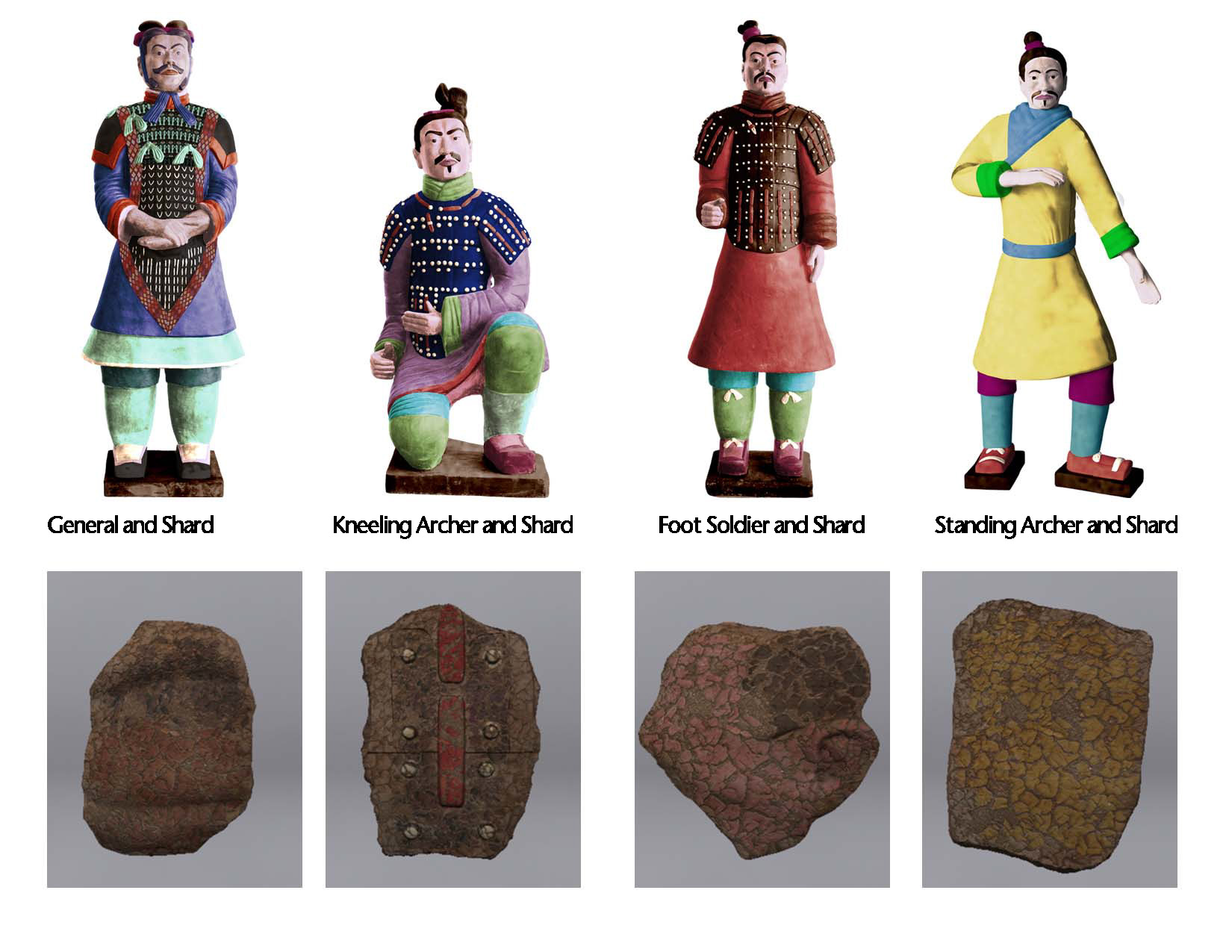
The various warrior types and their associated physical shard fragments — each embedded with a unique RFID chip that triggered the corresponding warrior content on the kiosk.
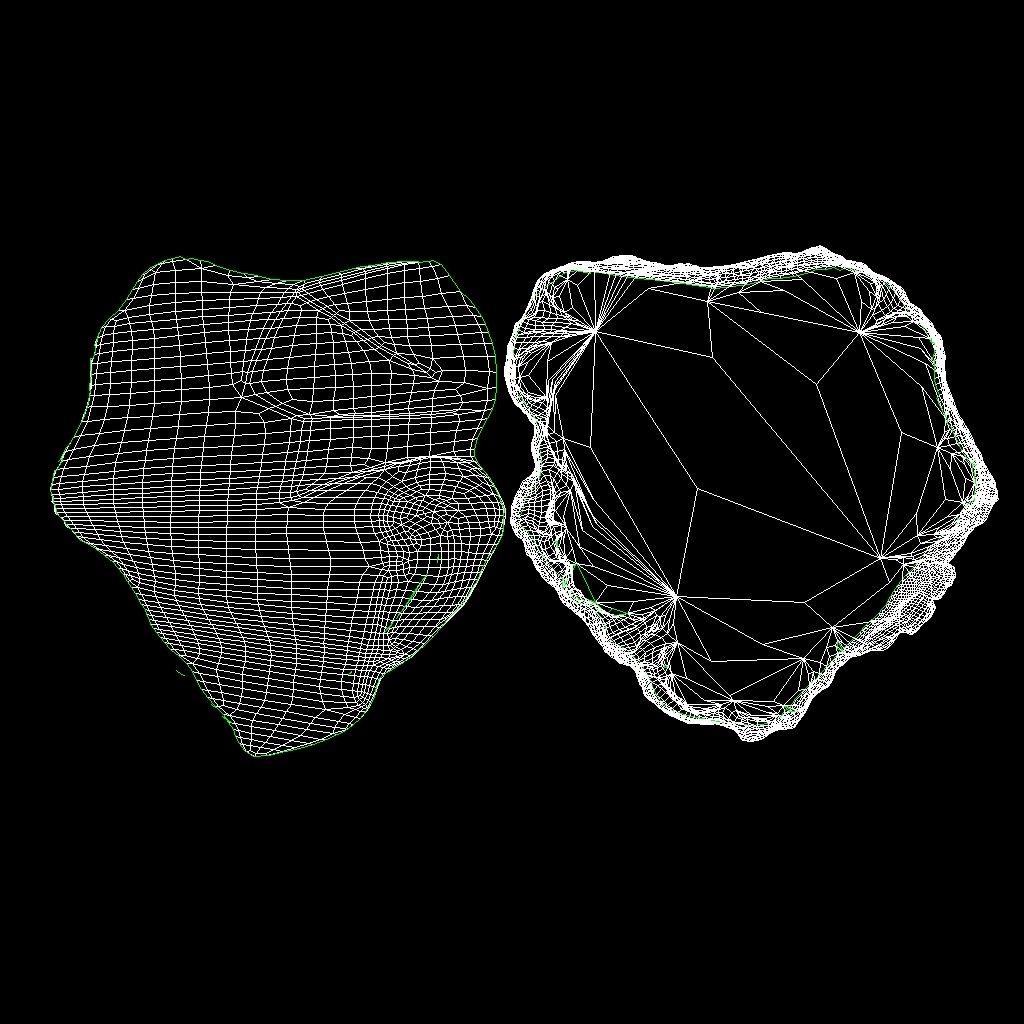
Wireframe model of the foot soldier shard — each fragment 3D-modeled to match the physical RFID prop visitors would hold in their hands.
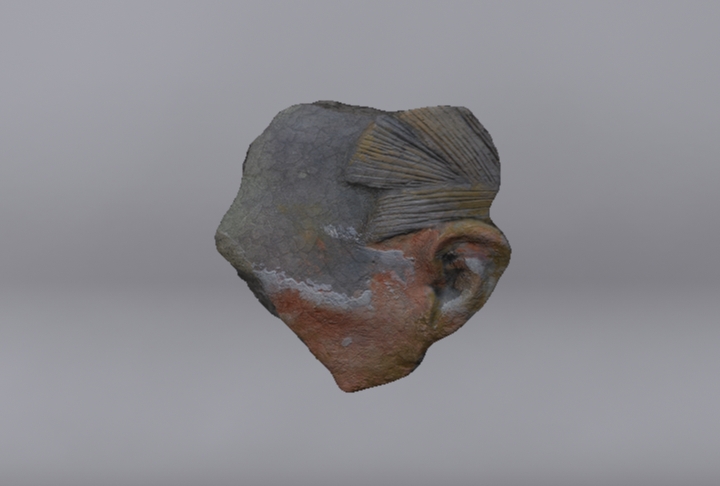
Final color render of the foot soldier shard — showing the reconstructed original pigmentation based on chemical analysis of actual archaeological fragments.
RFID TechnologyInteraction Design3ds MaxSketchBalsamiq
Discovery, wireframes, and stakeholder alignment
My task was to deliver educational and scientific information in an entertaining manner that worked for all age groups. That meant deploying nearly every software package and media skill in my toolkit: Photoshop, Illustrator, Sketch, Balsamiq, After Effects, 3ds Max, Audition, custom programming, and extensive research into the original painting schemes of the warriors.
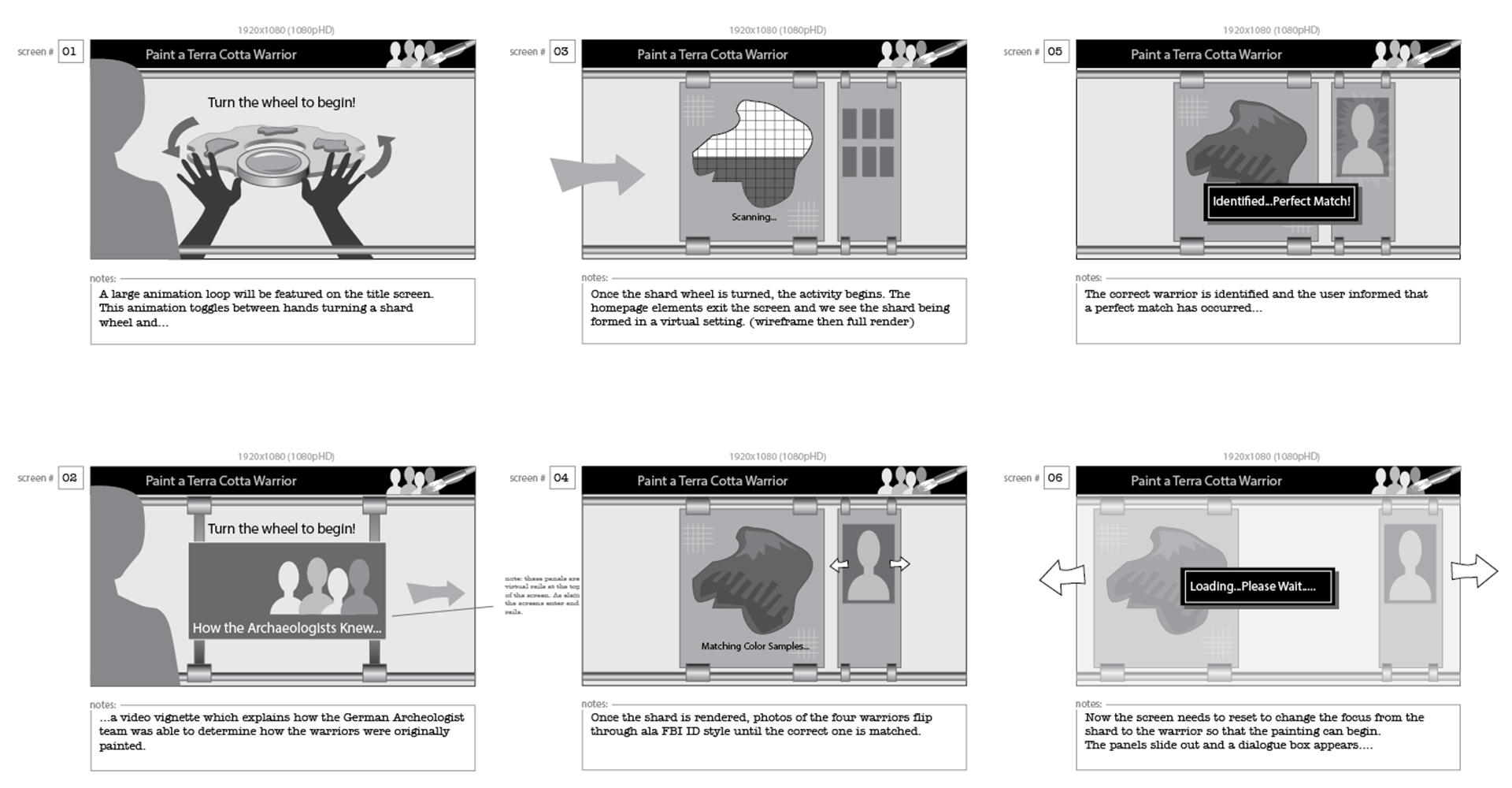
The process started with process flows, wireframes, and storyboards. I developed several iterations while collaborating with the educational staff at the museum to ensure the correct learning outcomes were embedded into the experience. Each iteration was walked through with stakeholders for feedback before advancing to the next stage.
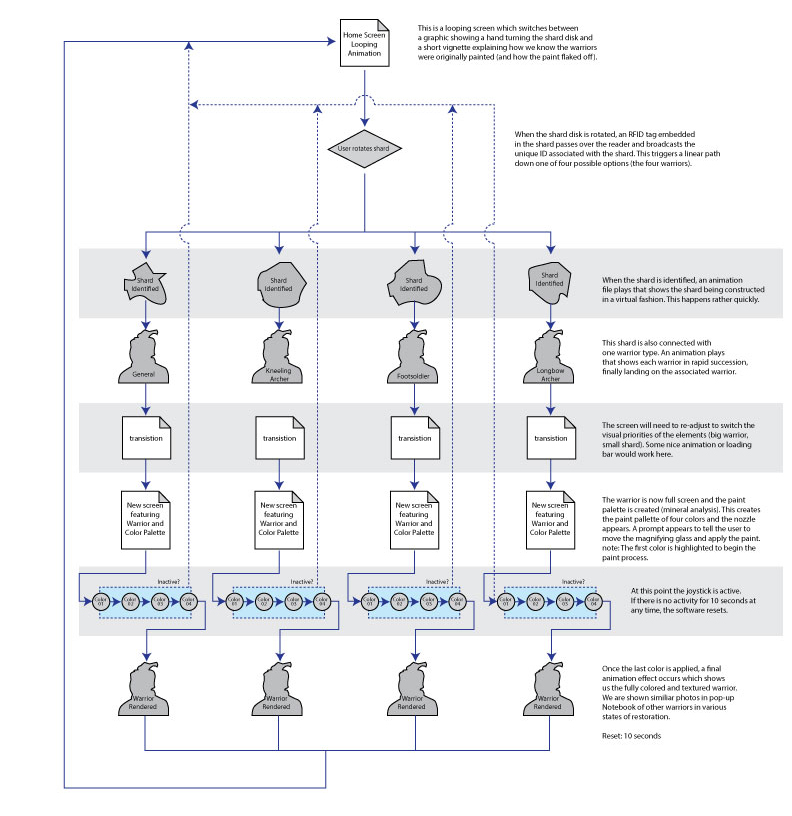
Process flow — mapping the full interaction logic from RFID scan through warrior selection, painting, and email delivery.
Storyboards — visualizing the narrative arc and key interaction beats of the kiosk experience before a single screen was designed.
01
Archaeological Research
Reviewed National Geographic documentation and scientific literature on original warrior pigmentation, chemical analysis methods, and the excavation history — ensuring the educational content was factually grounded.
02
Process Flow & Storyboarding
Mapped the full interaction logic including RFID trigger events, warrior selection, the painting interface, and the email delivery flow. Storyboards walked stakeholders through the experience before any screens were built.
03
Stakeholder Collaboration
Worked closely with the museum's educational staff to validate learning outcomes at each stage. Multiple iteration rounds refined both the content accuracy and the appropriateness of the interaction model for young visitors.
04
Wireframes & Prototype
Developed low-fidelity wireframes in Balsamiq and Sketch, progressing to interactive prototypes used for heuristic evaluation and usability testing before final interface production.
From notebook animation to the installed kiosk
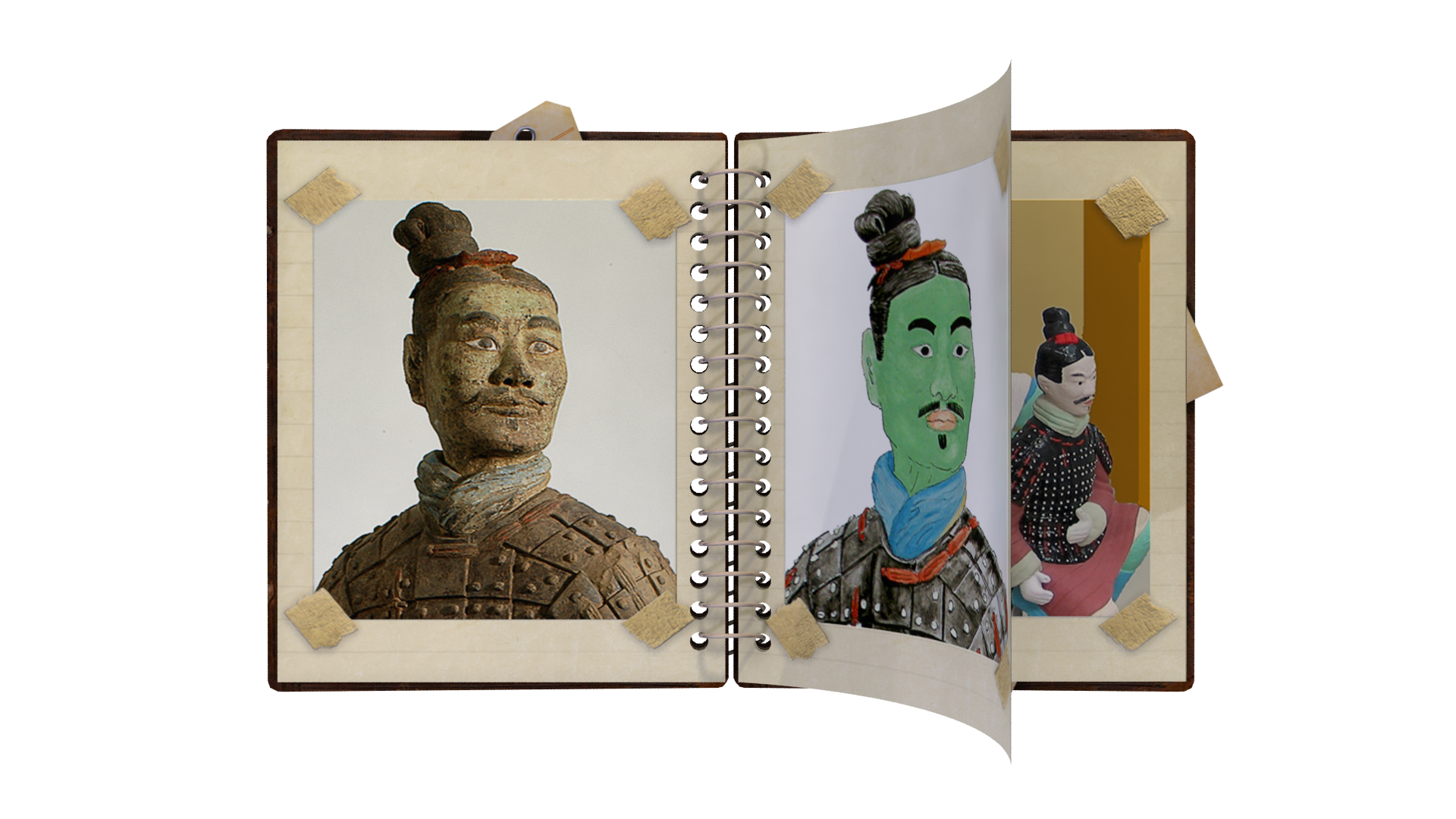
The experience needed an opening intro sequence that walked visitors through the discovery of the painted figures and explained how scientists determine which pigments were originally present. I designed and animated a hand-drawn notebook sequence to guide viewers through this backstory and introduce them to the kiosk interaction before they touched the screen.
A sample frame from the animated intro sequence — a hand-illustrated notebook style animation that taught visitors how the warriors were originally painted and how to use the kiosk.
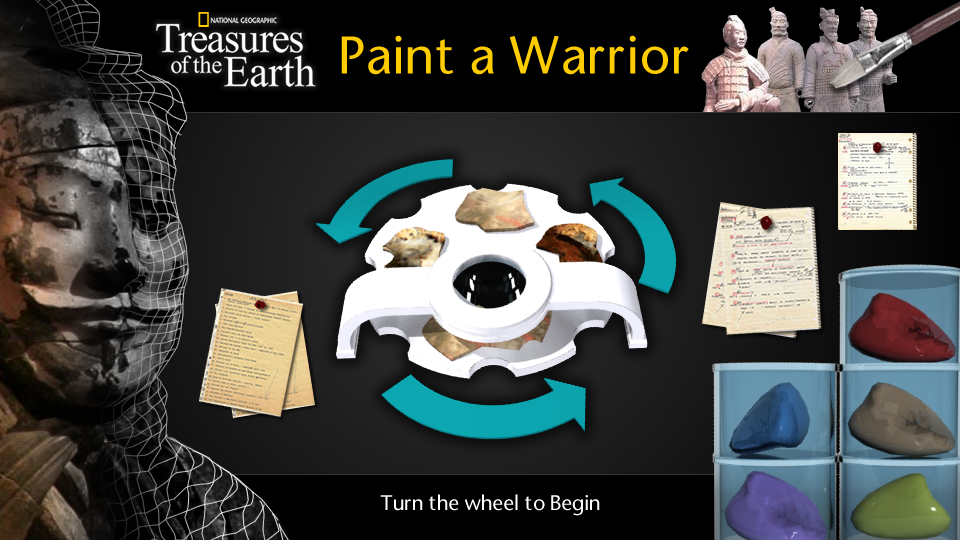
Early screen concept — establishing the visual tone and layout of the painting interface before full visual design.
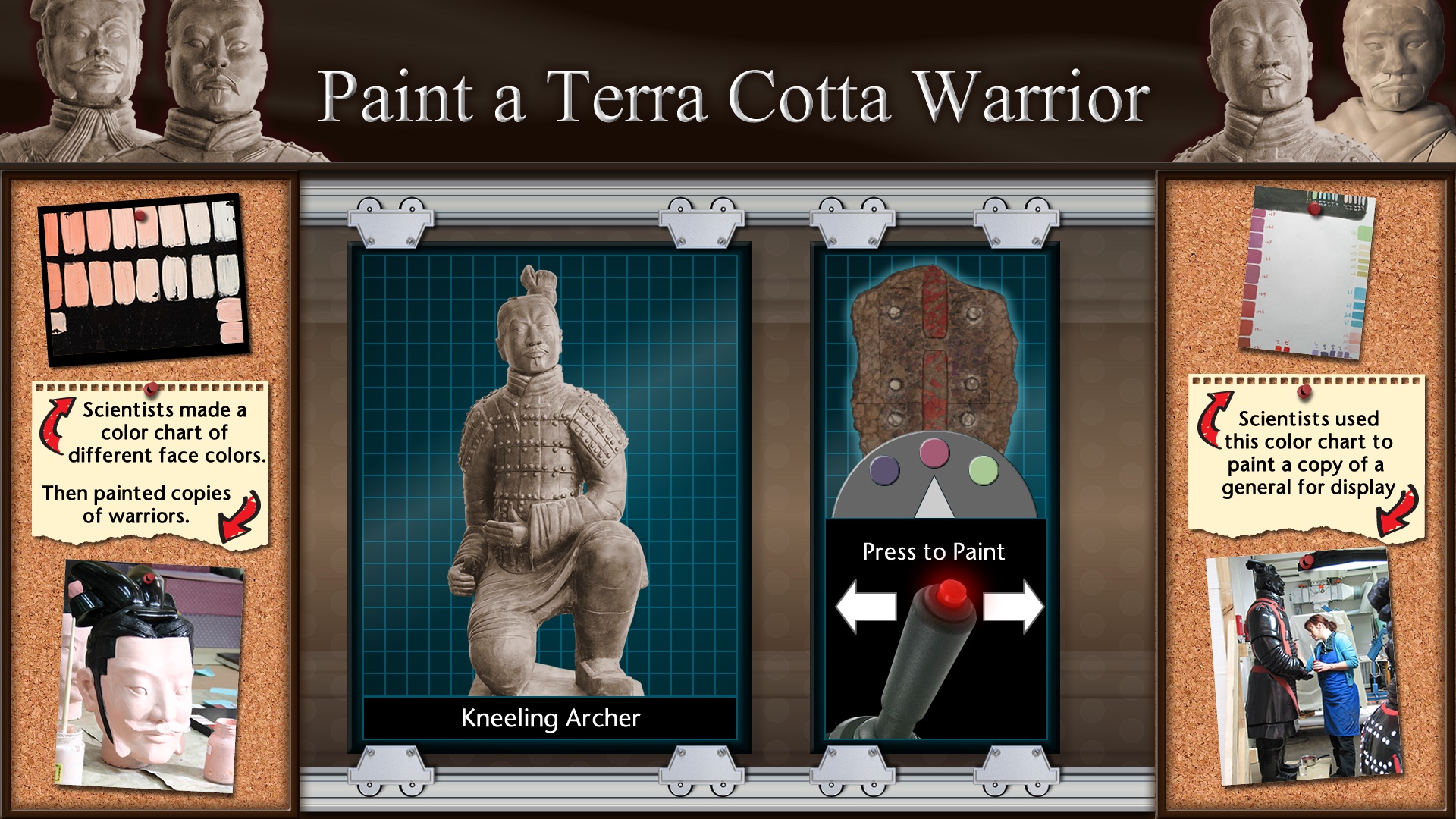
Refined interface — the final UI direction using a cork-board aesthetic to evoke the archaeological research and discovery theme of the exhibit.
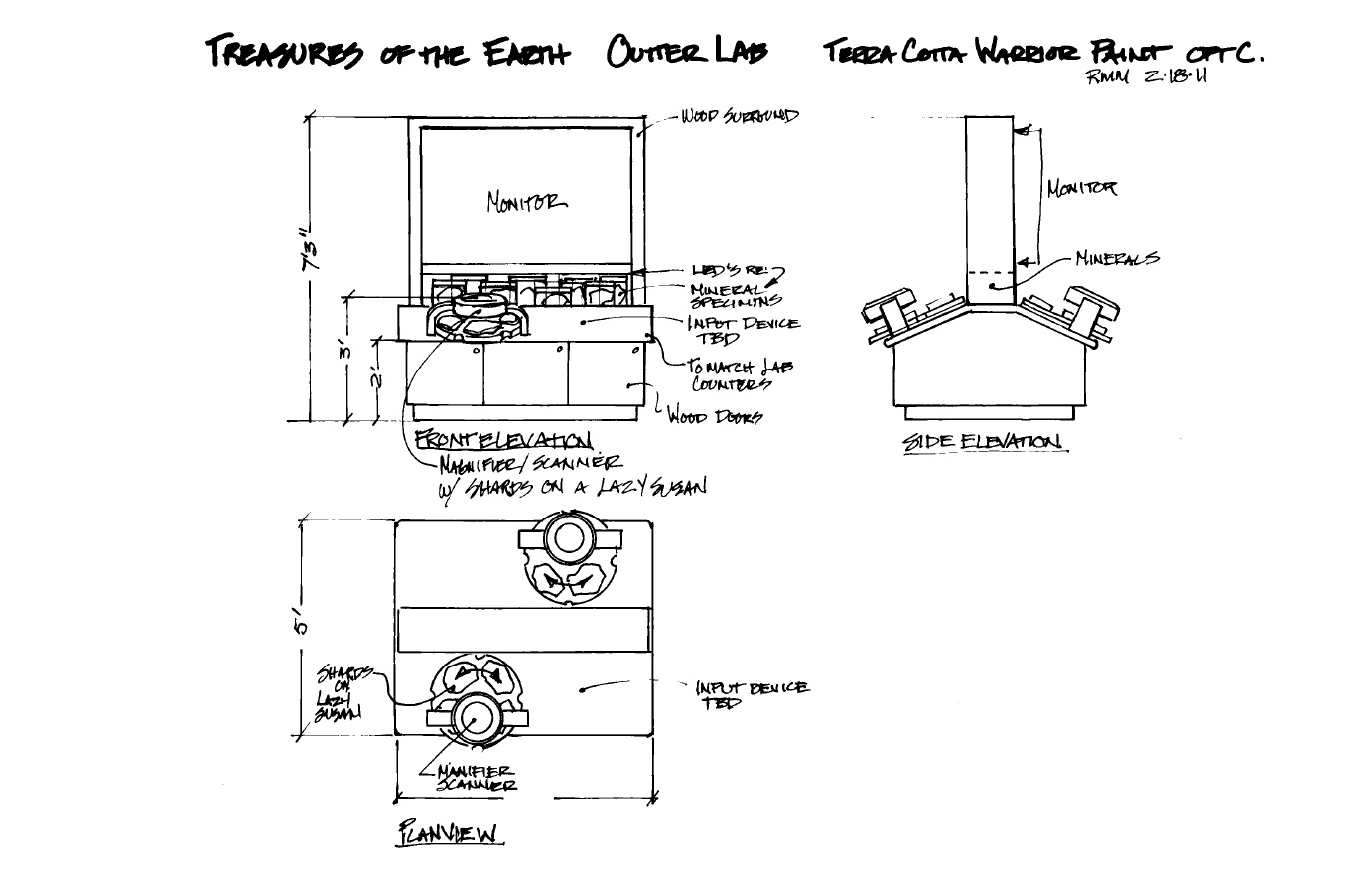
The kiosk design — a custom enclosure housing the touchscreen, RFID reader, and all supporting hardware, designed to complement the exhibit's aesthetic.
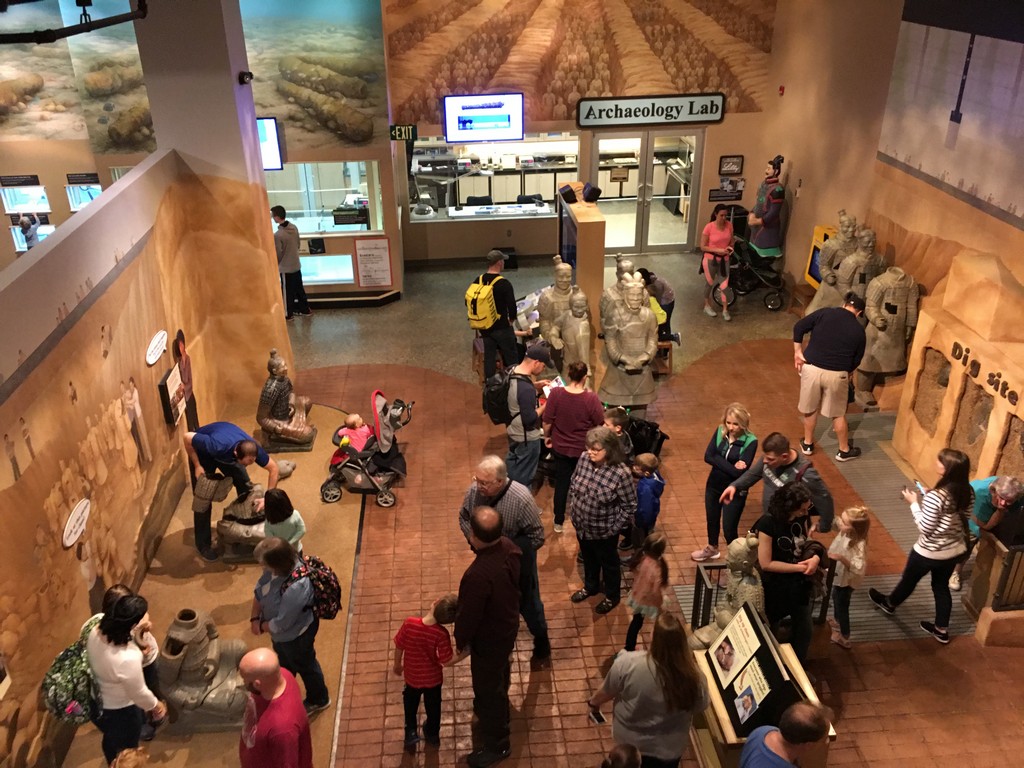
The installed kiosk — in its final home within the "Treasures of the Earth" exhibit, ready for museum visitors to pick up a shard and begin their painting journey.
Featured project on the Children's Museum of Indianapolis channel — the full "Paint a Warrior" kiosk experience as seen by exhibit visitors.
Terra Cotta Warriors — the widescreen film
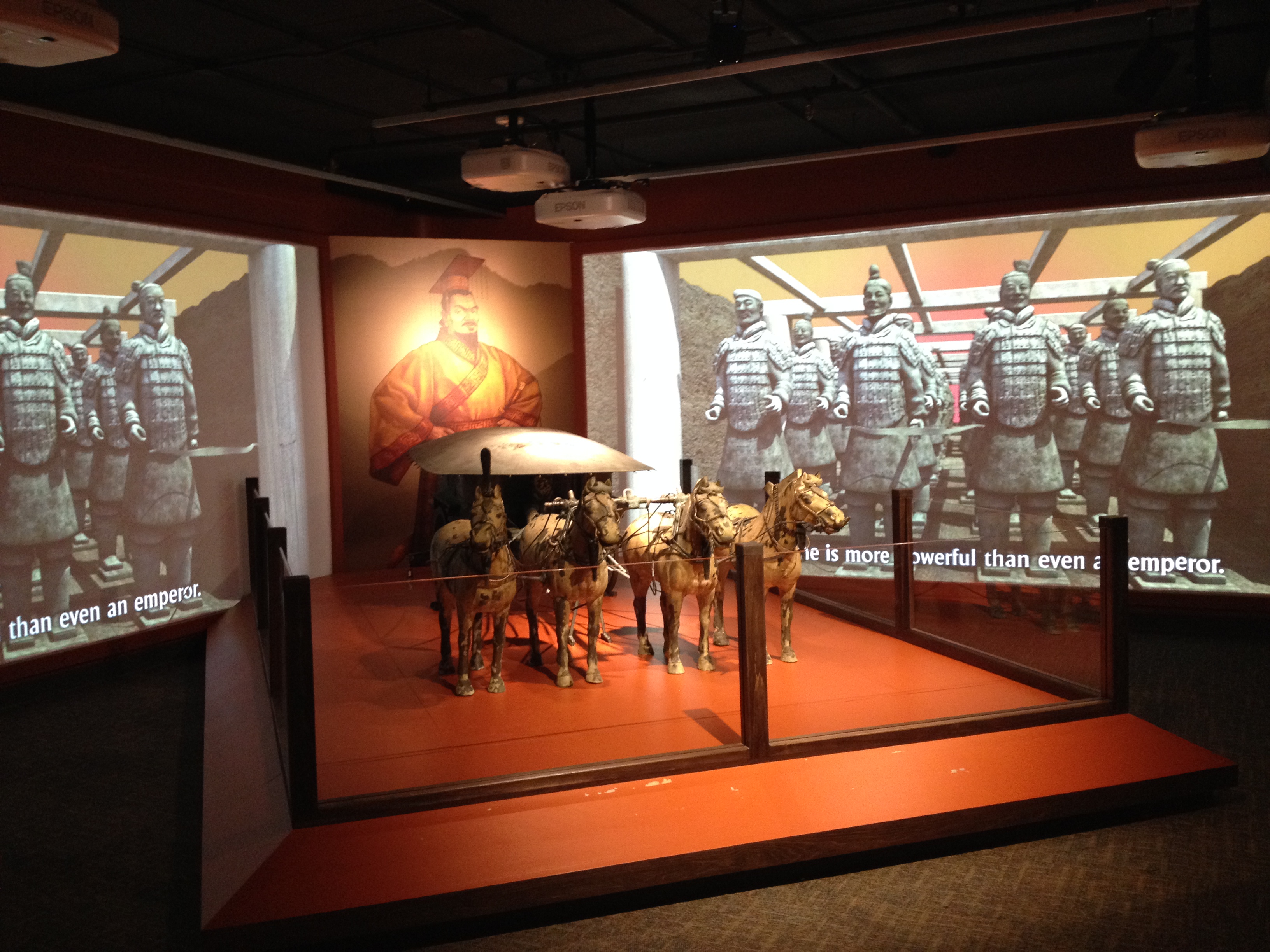
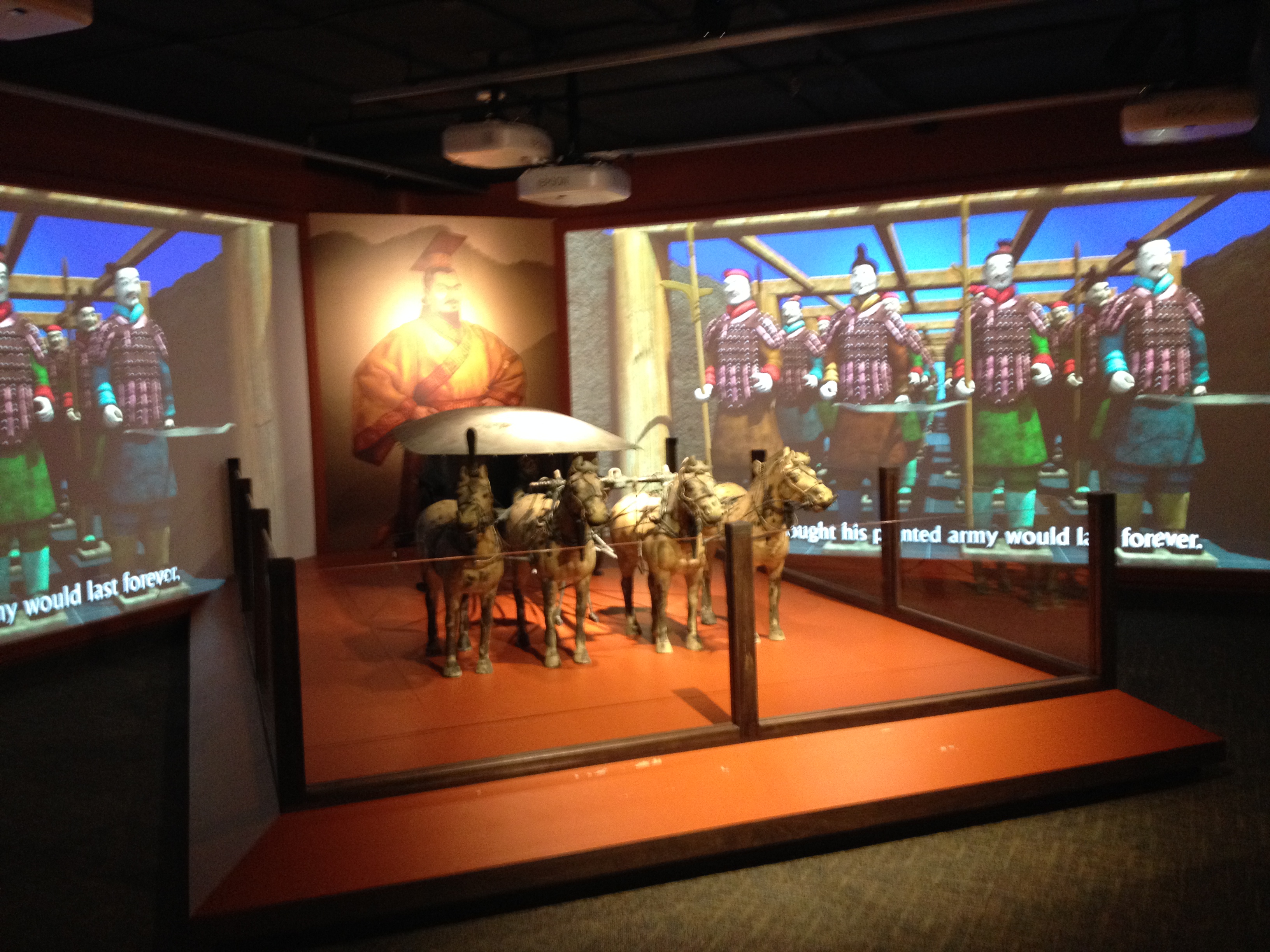
Alongside the interactive kiosk, I was also asked to create a 3D visualization film to run continuously within the exhibit space. The film needed to tell the story of how the warriors ended up in the ground, what they originally looked like, and how they deteriorated to the state we see today.
This part of the project was an exciting opportunity to collaborate with former co-workers and peers. It involved deep research into original painting schemes, pouring through documentation provided by National Geographic Magazine, and producing hundreds of reference renders before arriving at a finished result. The final widescreen movie represented the output of that extensive modeling and rendering effort.
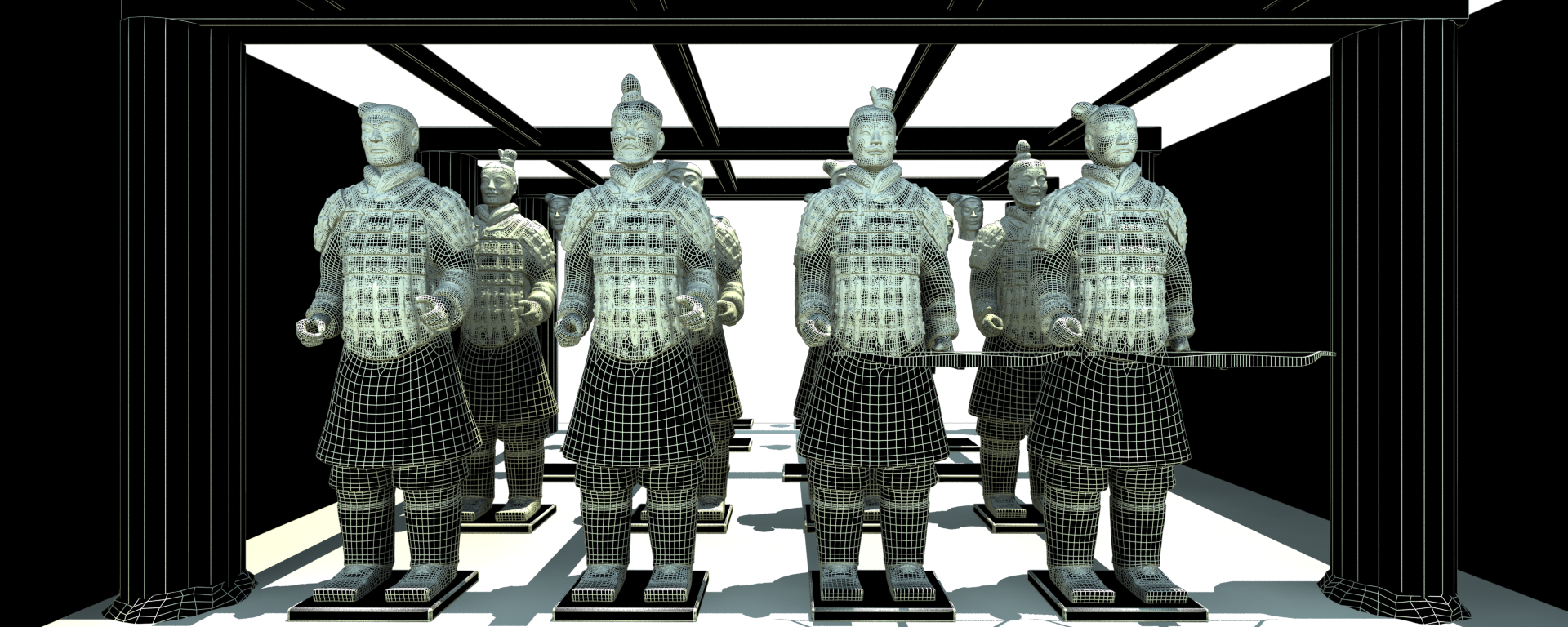
Wireframe still from the full warrior scene — one of hundreds of renders produced during the production process before reaching final color and texture output.
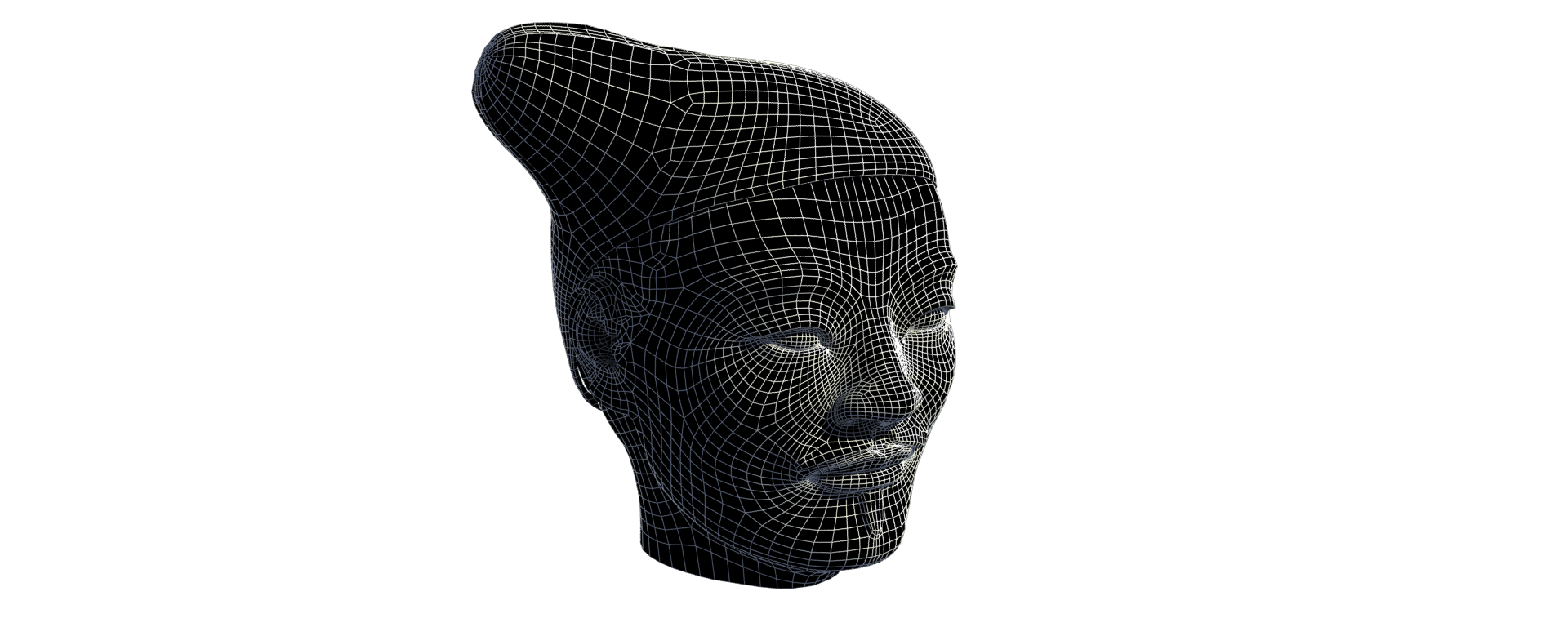
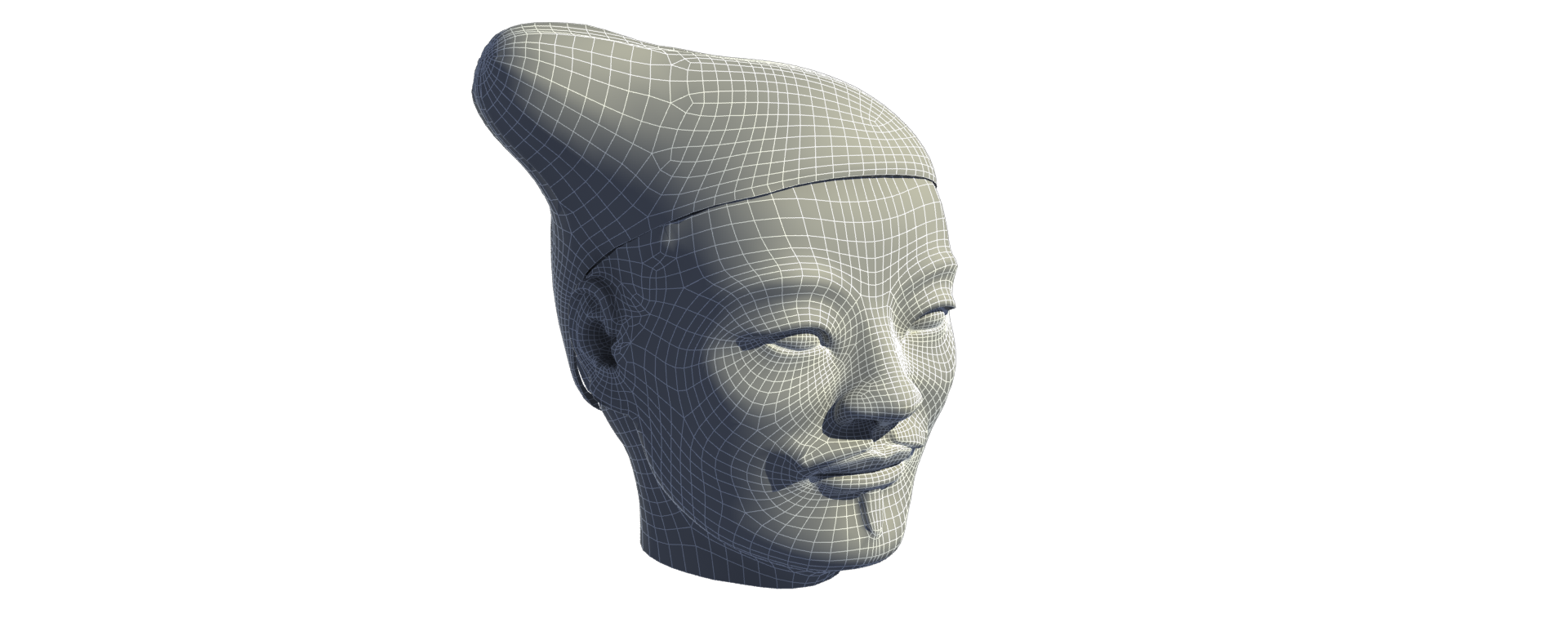
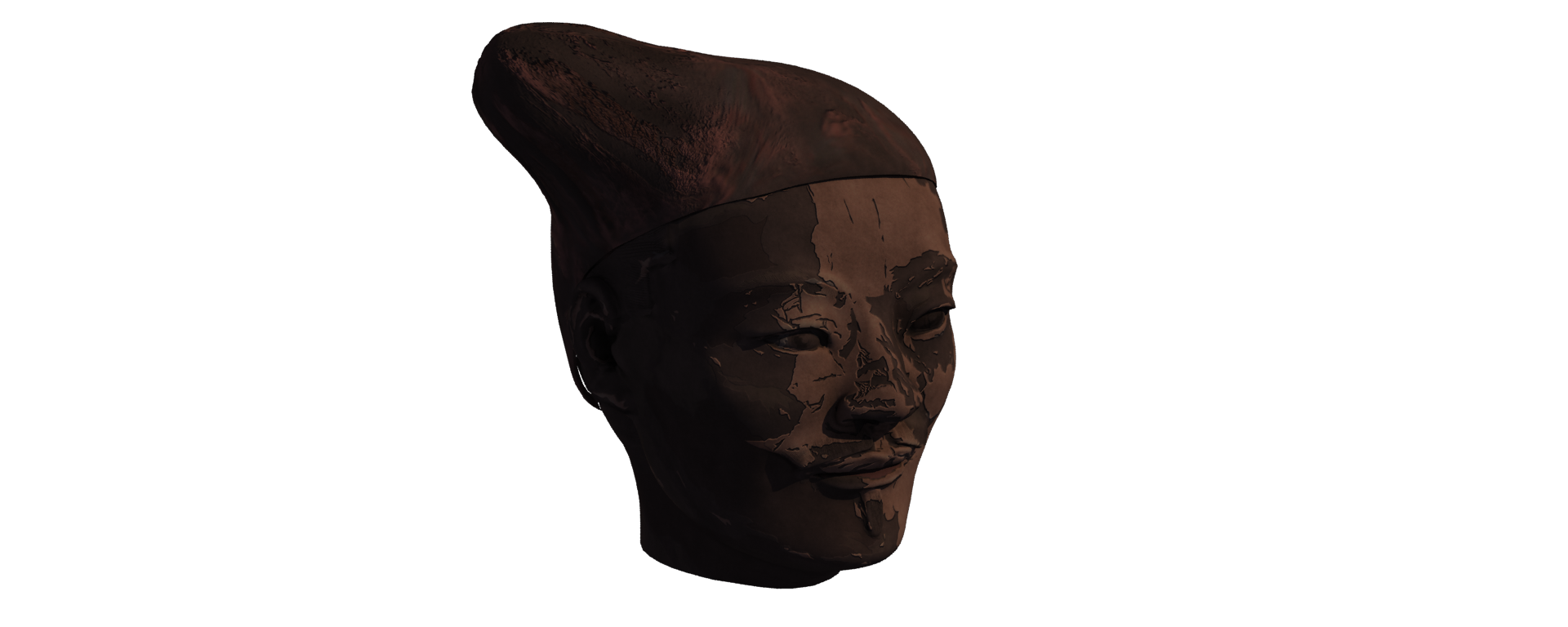
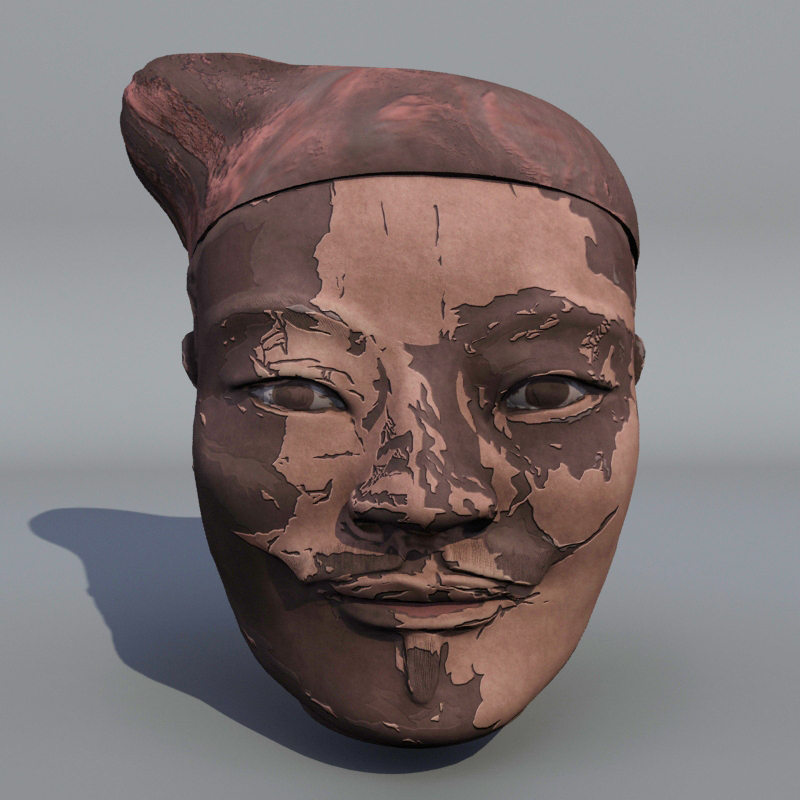
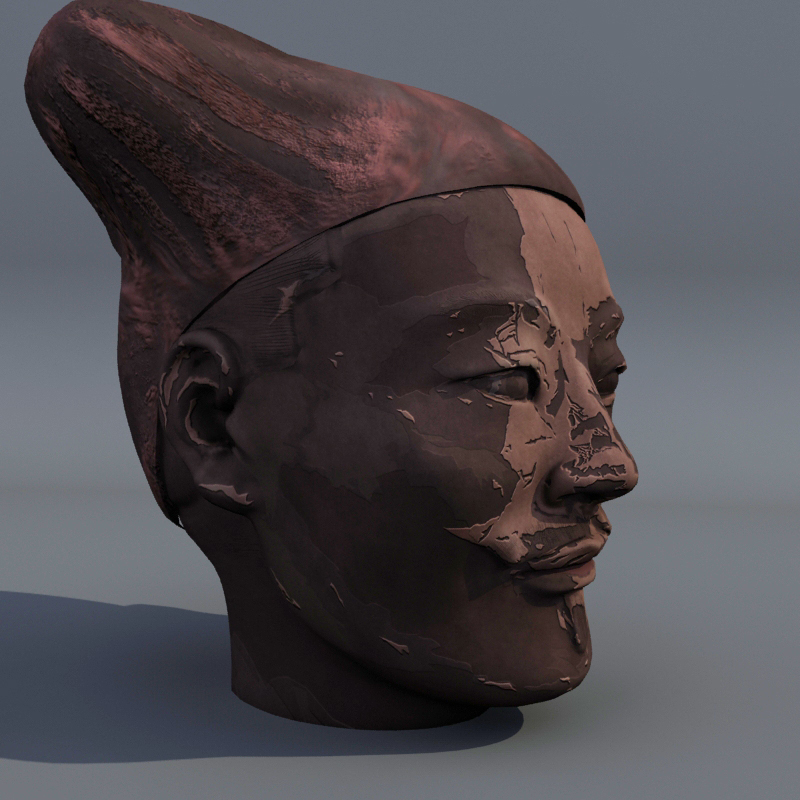
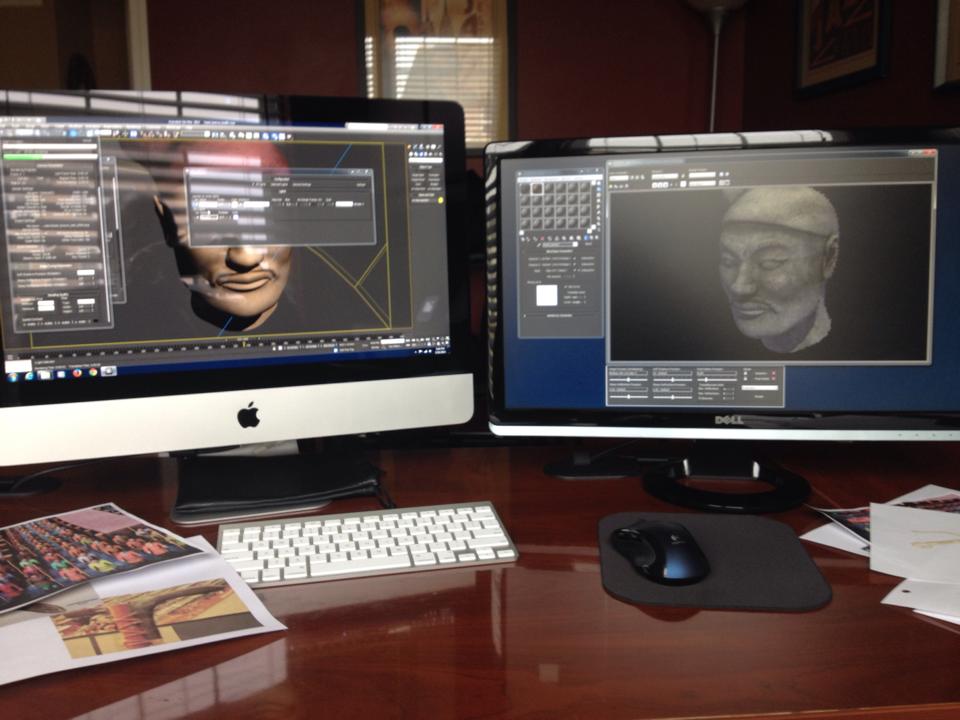
The warrior head was the most intricate modeling challenge — requiring accurate anatomical structure, historically informed painting schemes, and enough polygon detail to hold up in widescreen playback. The progression from wireframe to finished render took multiple major revision cycles.
Step 1 — Initial wireframe mesh of the warrior head, establishing proportions and polygon structure.
Step 2 — Refined wireframe with added surface detail and texturing guides applied over the base mesh.
Step 3 — Final color render with historically accurate pigmentation applied based on scientific analysis of excavated warrior fragments.
Revised head model — updated eye anatomy and facial pigmentation detail following stakeholder review of the initial renders.
Alternate angle showing the revised head's surface texture and secondary paint layer detail used in the final widescreen sequence.
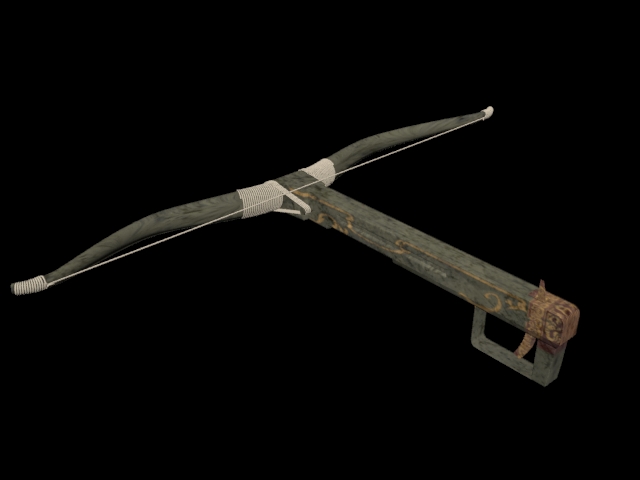
Crossbow model — one of the weapons and accessories modeled to populate the full warrior scene in the widescreen visualization.
Final warrior render — the fully textured and lit figure as it appeared in the widescreen exhibition film.
Reference photography — used alongside National Geographic documentation to ensure accurate surface texture and scale in the 3D models.
Additional artifact reference — details of excavated warrior components that informed the modeling of armor, weapons, and surface wear patterns.
Terra Cotta Warriors — the final 3D visualization film produced for the Children's Museum of Indianapolis exhibit, telling the story of the warriors' creation, burial, and discovery.
Award-winning interactives in six months
Both deliverables were produced and installed within the exhibit timeline, with the interactive kiosk going on to become the first RFID-based interactive in the Children's Museum of Indianapolis's history. The full project was recognized as award-winning work, produced within six months of rejoining and fully rebuilding a previously dissolved creative department.
What was delivered
✓
First RFID interactive at the Children's Museum of Indianapolis — a novel interaction model embedding coded chips into physical prop fragments, triggering custom touchscreen content for each warrior type.
✓
End-to-end UX process — covering the full spectrum from discovery research and educational stakeholder collaboration through wireframes, prototyping, heuristic evaluation, usability testing, and final delivery.
✓
Custom animated intro sequence — a hand-illustrated, animated notebook that taught visitors the science of warrior pigmentation and oriented them to the kiosk interaction model before they touched the screen.
✓
Widescreen 3D visualization film — an exhibition-quality animated film narrating the warriors' creation, burial, and modern discovery, backed by extensive National Geographic research and hundreds of production renders.
✓
Featured by the Children's Museum of Indianapolis — the "Paint a Warrior" kiosk experience was highlighted on the museum's official channel as a signature exhibit activity.
Reflection
What made this project especially meaningful was that it demanded the full range of design and production skills simultaneously — from UX research and educational design to 3D modeling, animation, and hardware integration. There was no playbook for embedding RFID chips into physical props and wiring them into a museum touchscreen experience. Every element had to be invented from scratch, in tight collaboration with the museum's educational team, within a fixed installation deadline.
The discipline required to deliver two production-quality interactives — both the kiosk and the 3D film — within six months shaped how I think about what's possible when you combine rigorous process with genuine creative ambition. This project remains one of the most technically and creatively demanding I've undertaken, and one of the most rewarding to see in the hands of real visitors.